Laufdorf, 17 November 2026
The members of the Basisgemeinde community in Wulfshagenerhütten watch out, as far as possible, for ways to keep their money and even indirect support away from the spiral of re-armament. They invite us all to do the same in the places where we live.
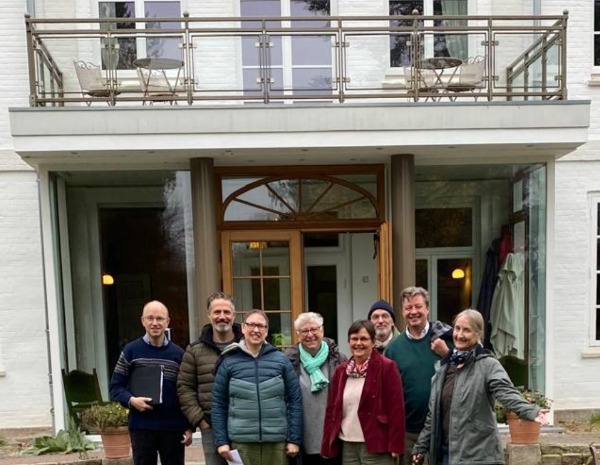
The board of Church and Peace met over 6th-8th November 2026 for its autumn meeting at the Basisgemeinde community in Wulfshagenerhütten, Gettorf near Kiel, in Germany.
The Basisgemeinde community has been a member of Church and Peace, the ecumenical peace church network in Europe, for many years. The area where the community lives is affected by the growing re-armament industry, which creates jobs and raises money for the region, with the consequence that people are convinced by the ideology of security through weapons and ultimately their use in the event of war.
Christian communities and ministers in the whole of Germany are currently grappling with the text of the ‘Ecumenical Framework: chaplaincy and acute intervention in the case of tensions, alliances and defence’ for the event of war: https://www.ekd.de/oekumenisches-rahmenkonzept-seelsorge-95115.htm. Through this ‘Spiritual Plan of Battle’, churches are being incorporated within the German Government’s security policy abusively, without being asked. Chaplaincy is being instrumentalised for the event of war.
A thoughtful podcast on this topic, in which Gottfried Orth, Church and Peace member, is one of the speakers, is available here in German:
https://www.ndr.de/nachrichten/info/zwischen-friedensethik-und-militaerischem-ernstfall-wie-bereiten-sich-die-kirchen-auf-konfliktlagen-vor-audio-3526024.html
The Basisgemeinde community in Wulfshagenerhütten has been manufacturing high-quality wooden play equipment for pre-school children, which enable children to develop their motor, mental, cognitive and social abilities. Producing and selling the equipment, as well as the holistic educational philosophy behind it, is one of the ways in which the community contributes to building a more peaceful and non-violent world.
Due to the debate about reintroducing military service in Germany, the younger generation there is facing the challenge of deciding what sort of future they want and how they want to build it. The Gen Z protests show that young people do not want to go to war for Germany’s sake. Like the student protests in France, the demonstrations in Germany have been overwhelmingly non-violent and creative, even if the media often only report about rioting.
As Church and Peace, we welcome the fact that young people are aware of the gravity of the situation and are expressing it. In Germany, like in France, where teachers, parents and health care workers have joined in with the movement, they remind us all of the price of re-armament and war: a lack of money for basic social services, education and health provision, and for everything which creates balance and dignity in our society.
Church and Peace board member Siniša Klem from the south-eastern area of Europe reported on the non-violent protests in Serbia, which began two years ago and eventually led to new elections at the end of October. He spoke about the paradigm shift involved, which was indeed a miracle. He asked a rhetorical question about when in the history of Serbia protests could have gone on for two years and kept to a policy of non-violence. Although many questions remain and many concerns are justified, for example regarding foreign policy, the experience that non-violent protests are successful will become part of people’s collective memory.
In reference to a quote from one of Paul’s letters, at Church and Peace we identify as people who are ‘living letters’ (2 Corinthians 3: 3). By visits and contact in the east, west, south and north of Europe, we challenge and encourage each other through constant dialogue and sharing of experiences. ‘We don’t break off contact when we don’t like something about the other person’, said Anja Vollendorf, the president of Church and Peace. ‘On the contrary, we strengthen the contact’.
As part of our projects for 2027, we are planning to organise a ‘living letter’ visit to Albania in order to prepare for the 2028 European conference of Church and Peace 2028.
The 2027 conference of Church and Peace will take place from 29-31 October in Strasbourg.
Signed on behalf of the board by Maria Biedrawa, vice president of Church and Peace.