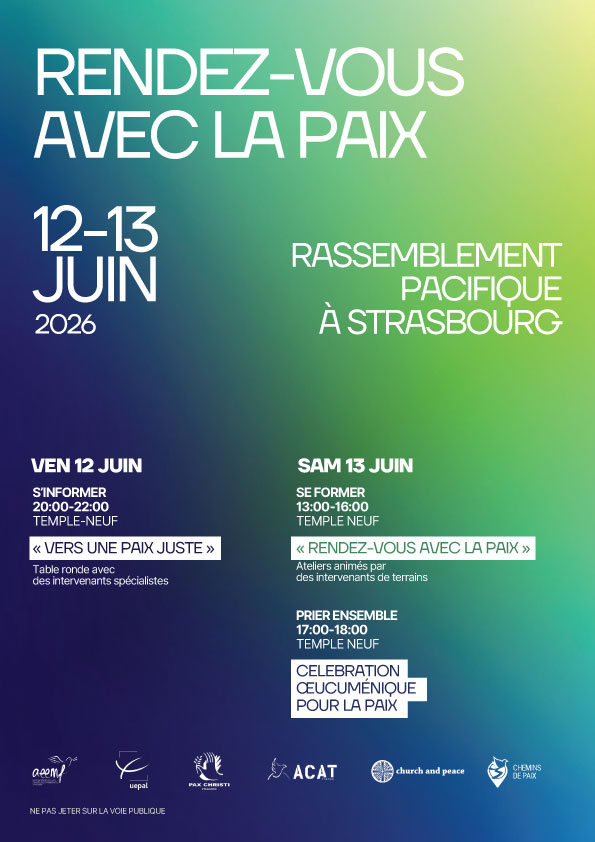
“A Rendez-vous with Peace” was the title of an event held over the weekend of 12–13 June 2026 in and outside the Temple Neuf, an old Lutheran church right in the centre of Strasbourg.
The event was organised by several peace initiatives and churches from the local area and the wider region: the Union of Mennonite Churches in France (UEMF), the Union of Protestant Churches in Alsace and Lorraine (UEPAL), Pax Christi, the Christian Action Alliance for the Abolition of Torture (ACAT), Church and Peace, and Chemins de Paix, a peace initiative that supports and connects local groups and other peace initiatives. A colourful, ecumenical and international mix of peace-loving people who are active in these organisations.
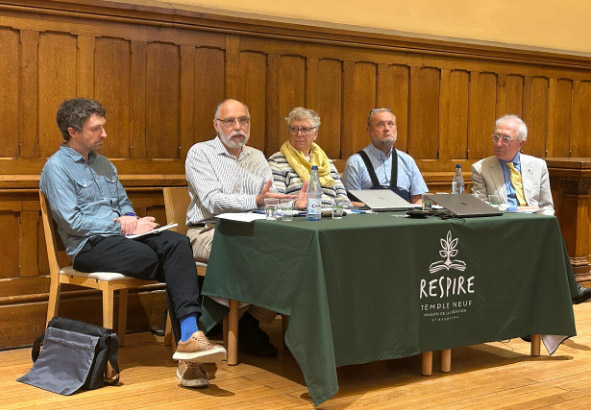
Friday evening began with a round-table discussion to learn about peace issues in the face of war, about significant steps towards a just peace, and about the possibilities for its implementation. Philippe Richard, who holds a PhD in International Law, Defence and Security, spoke on human rights issues. Frédéric Rognon, a professor of philosophy and religion, Maria Biedrawa, a board member of Church and Peace, and Ludovic Fresse from the ‘Street of Remembrance’ (‘Rue de la Mémoire’) shared their thoughts and experiences on the following questions:
• How has the discourse on peace gradually emerged over the centuries in relation to the discourse on war?
• What are the essential components of a just peace?
• What is the value of promoting a discourse on just peace that reverses the paradigm of just war?
Today, the churches rightly recognise that the doctrine of ‘just war’ is no longer a viable concept. At the same time, however, the mistaken notion that security can only be achieved through rearmament and preparations for war is once again gaining ground worldwide. In contrast, Dietrich Bonhoeffer reminded us: “To demand security is to harbour mistrust, and mistrust breeds war. Everywhere, people confuse security with peace.”
Peace arises through dialogue and through respect for the rights of all people. It must be founded on both international law and faith. As the Bible says: ‘Mercy and truth meet together; righteousness and peace embrace each other.’ (Psalm 85:11)
Whilst the law of the strongest often still prevails in international relations and within many power structures, we can, at our own level, begin by building and nurturing relationships with the people around us. Although every individual can be a peacemaker in their daily lives, the experiences from Sudan, as reported by Maria Biedrawa, and the recent developments in South Korea, as discussed by Frédéric Rognon, show that it is also necessary to work alongside others to stand up for peace and non-violence.
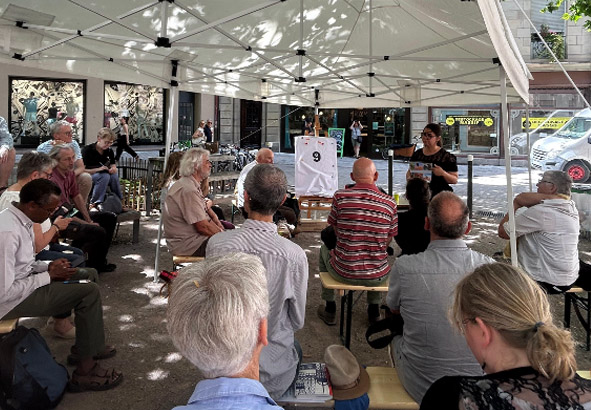
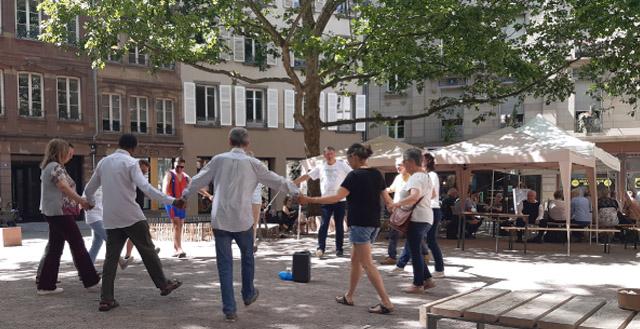
Whilst Friday evening was mainly devoted to providing information on the topic, Saturday afternoon focused on formation, the practical training relating to various aspects of peace. Four workshops took place, one after another, in the open air on the square directly in front of the Temple Neuf. The format was always the same: a 25-minute introduction to the topic by a workshop leader, 5 minutes for questions, and 10 minutes to dance for peace in the centre of the square (led by Dorothea Wagner from the Liebfrauenhof to the song ‘Para la guerra nada’ by Marta Gómez) and for a prayer for peace recited together.
Nadine Salaün of Pax Christi summed up her topic in a question: Is managing one’s emotions the first step towards peace? Peace is something that is learnt and begins with oneself. By knowing oneself and being mindful of how human emotions work.
Maria Biedrawa, co-chair of Church and Peace, spoke on the following topic: When sharing traumatic experiences becomes a bridge to peace. War destroys more than just infrastructure. Traumatic experiences leave a deep mark on the body, the heart and the mind, and on our ability to have faith in life and to live together. There is a ‘before’ and an ‘after’; one never forgets. However, a path can open up through the question: How do I deal with what has been done to me?
Florence Nicot, from the Mennonite Church and a teacher of modern literature at a secondary school, focused on learning about peace: becoming a peacemaker can be learnt! Mediation in school is a tool which is given to young people to help them, through experience and practical techniques, to understand tensions, defuse conflicts and become ambassadors for peace in their everyday lives. The crisis then becomes an opportunity to build more just relationships.
The final workshop was led by Betty and Claude Braun, who run the Jean Goss Peace Centre in northern Alsace and are members of the Le Soc association. Their topic was conscientious objection, which has regained significance in France today, but also in other countries, in light of the militarisation of society.
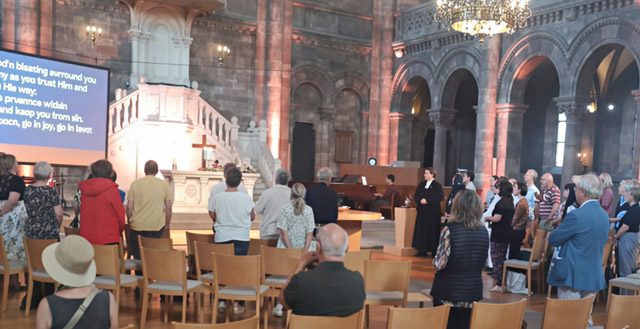
To mark the end of the ‘Rendez-vous with Peace’, an ecumenical service was held in the church, attended by around 60 people. Also present were Bishop Emeritus Marc Stenger from Troyes and the Greek Orthodox Father Christos Filiotis-Vlachavas.
In summary, it can be said that on both days, the participants were ‘amongst themselves’, meaning that people from outside the ‘peace bubble’ did not attend the events. However, the workshops held in front of the church were open to the public. Quite a few people sitting on the benches – right next to our workshop tents – picked up on what was being discussed. And the music and peace dances in the middle of the square were impossible to miss or ignore; when invited, some passers-by even joined in with the circle dance and danced with the others.
In this respect, the event was not merely an insider affair, but – like demonstrations – had an external impact, albeit a limited one.
This ‘Rendez-vous with Peace’ was truly a meeting with peace for us peace-loving people who have fallen in love with peace, or for whom that love has been rekindled.
Stefan Walter (Liebfrauenhof), Mike Zipser (Church and Peace)